
The Pomodoro Technique for College Students

Effective learning strategies can completely transform your college experience, but let me start with a really honest confession that’ll probably make you feel way better about your own focus struggles. During my sophomore year, I had the attention span of a goldfish on espresso, and sitting still for more than fifteen minutes felt like actual physical torture.
Picture this disaster: I’d plop down at my desk with grand plans to conquer three economics chapters, armed with enough highlighters to paint a rainbow and motivation that could power half the campus. Five minutes in, I’d be scrolling through TikTok. Ten minutes later, I’d convince myself that reorganizing my bookshelf was absolutely essential for academic success. By the twenty minute mark, I’d be in the kitchen making my fourth snack because “brain food is important,” right?
That’s when my study buddy introduced me to this bizarre Italian productivity method involving kitchen timers shaped like tomatoes. Yeah, you heard that right. I thought she’d completely lost her marbles, but I was desperate enough to try anything, and honestly, this simple technique became one of the most effective learning strategies I’ve ever discovered.
What Makes This Tomato Timer Method So Special
The Pomodoro Technique gets its quirky name from those adorable tomato shaped kitchen timers that Francesco Cirillo used back in the 1980s when he was a struggling university student just like us. The concept is almost embarrassingly simple: work for 25 minutes, take a 5 minute break, rinse and repeat. After four cycles, you reward yourself with a longer break of 15 to 30 minutes.

Sounds way too simple to actually work, doesn’t it? That’s exactly what I thought when I first heard about it, but here’s the thing your professors never tell you: your brain can only maintain peak focus for limited periods before it starts wandering off to more interesting territories like what you’re having for dinner or whether your crush from freshman orientation ever thinks about you.
Instead of fighting against your brain’s natural attention patterns, this technique works with them as one of the most practical effective learning strategies available. You’re essentially bribing your mind to stay focused by promising it regular breaks, kind of like negotiating with a cranky toddler who refuses to sit still during a long car ride.
Why Effective Learning Strategies Like Pomodoro Work for Overwhelmed Students
College life is basically a perfect storm of digital distractions, crushing workloads, and the constant temptation to procrastinate until you’re pulling all nighters fueled by energy drinks and pure panic. Traditional study advice tells you to just “focus better” or “eliminate distractions,” but that’s about as helpful as telling someone to “just be taller” when they can’t reach something on the top shelf.
Among all the effective learning strategies out there, the Pomodoro Technique stands out because it acknowledges a fundamental truth: you’re human, your attention span isn’t infinite, and fighting against your brain’s natural rhythms is exhausting and ultimately counterproductive. When you know you only have to focus for 25 minutes, even the most mind numbing subjects suddenly seem manageable.
Those built in breaks aren’t just downtime either. They’re actually crucial for memory consolidation and preventing the kind of mental fatigue that makes you feel like your brain is made of cotton balls. Your mind needs those brief rest periods to process information and recharge for the next focused work session.
Core Benefits for College Students:
- Transforms overwhelming projects into bite sized chunks
- Dramatically reduces procrastination and study anxiety
- Improves the actual quality of focus during work periods
- Provides regular mental breaks to prevent academic burnout
- Creates a sustainable study rhythm you can maintain long term
Real World Success: From Academic Chaos to Focused Success
Let me tell you about Jake, a junior psychology major who stumbled into my office looking like he hadn’t slept in three weeks. This brilliant kid was drowning in coursework, pulling regular all nighters, and still feeling like he was constantly behind despite spending practically every waking hour with his nose in textbooks. His study sessions were these brutal marathon affairs that left him mentally fried but with surprisingly little actual progress to show for all that effort.
Jake’s biggest problem was sitting down to study and immediately feeling paralyzed by the sheer mountain of work staring back at him. He’d spend more time stressing about everything he had to accomplish than actually accomplishing any of it. When he did manage to start working, he’d push through for hours without breaks, thinking that stopping would somehow make him less productive or dedicated.
We introduced effective learning strategies starting with the Pomodoro Technique, implementing it gradually with just his most challenging subject at first. Those initial sessions felt weird because Jake was so accustomed to marathon study binges, but something fascinating started happening. His 25 minute focused bursts were actually more productive than those previous hours long sessions because his attention wasn’t scattered across multiple tasks and worries.
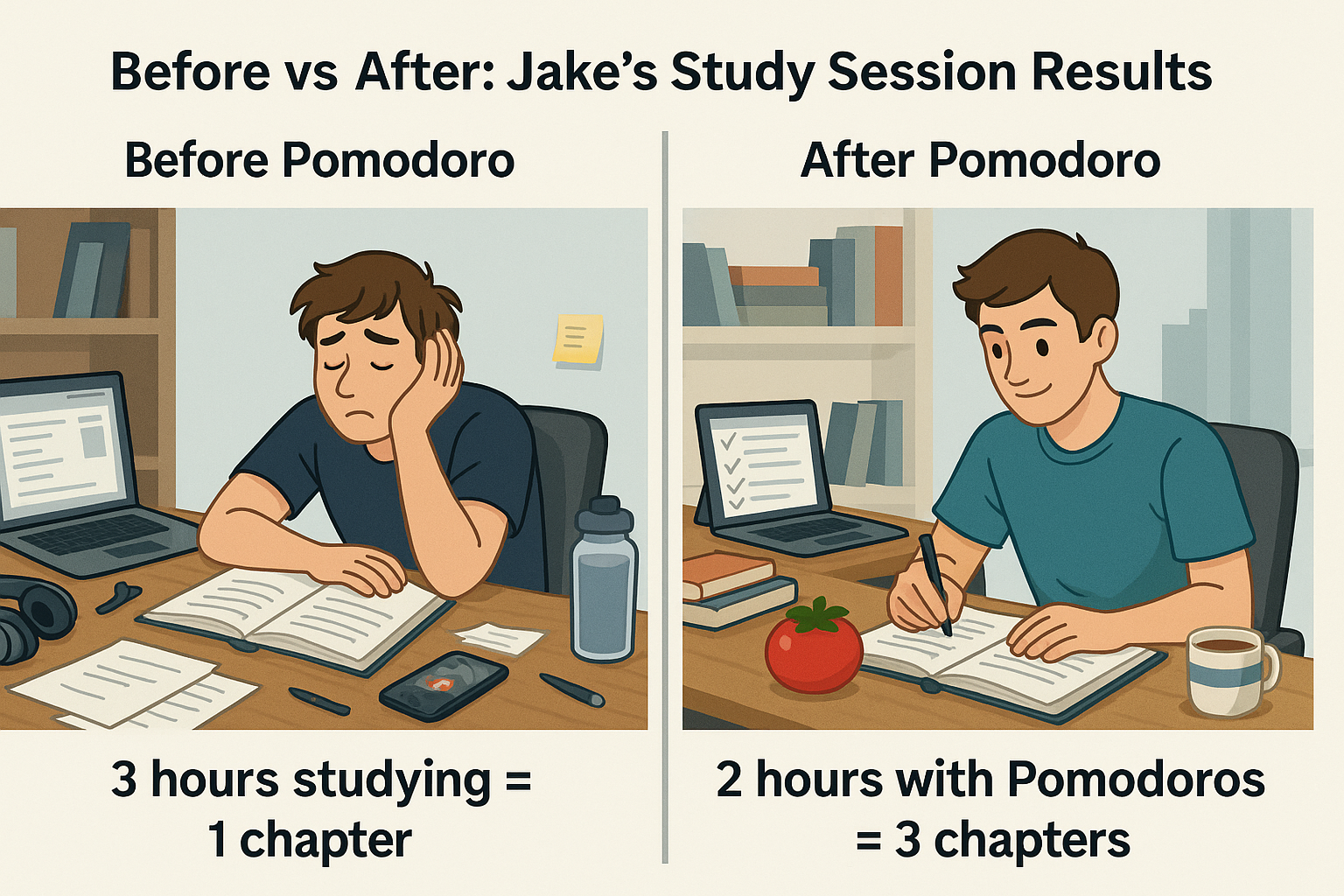
Within just four weeks, Jake had completely revolutionized his approach to studying. He was accomplishing more in less time, sleeping like a normal human being, and actually had energy left over for things like eating proper meals and maintaining friendships. The technique didn’t just boost his grades; it gave him back his sanity and social life.
Setting Up Your Pomodoro System Using Proven Effective Learning strategies
Getting started with this approach is refreshingly straightforward, but there are specific tweaks that work especially well for academic work and align with other effective learning strategies. You’ll need a timer (your phone works perfectly fine, though dedicated apps can add helpful features), a clean workspace free from obvious distractions, and a realistic plan for what you want to accomplish during each session.
Before starting your first pomodoro, spend a few minutes breaking down your study session into specific, concrete tasks that you can actually complete. Instead of writing “study for chemistry test” on your to do list, try “review chapter 7 notes” or “practice stoichiometry problems 1 through 15.” Vague goals lead to unfocused work sessions and that familiar feeling of spinning your wheels without making any real progress.
Choose tasks that genuinely fit into 25 minute chunks without feeling rushed or leaving you hanging in the middle of complex problems. If something seems too big, break it down further into smaller components. If it’s too small, group several related tasks together into a logical sequence.
Essential Setup Steps:
- Find a quiet, dedicated study space away from high traffic areas
- Gather all necessary materials before starting your timer
- Write down specific, measurable goals for each pomodoro session
- Turn off notifications on all devices that might interrupt your flow
- Set your timer and commit to the full 25 minutes no matter what
- Plan exactly what you’ll do during your 5 minute breaks
Adapting This Method as Part of Your Broader Effective Learning Strategies
Not all studying is created equal, and one of the reasons this ranks among the most flexible effective learning strategies is how adaptable it becomes once you understand the underlying principles. Reading dense textbook chapters might work perfectly with standard 25 minute intervals, but complex problem solving in calculus or lengthy coding assignments might benefit from slightly different approaches.
For subjects requiring deep analytical thinking or multi step problem solving, consider extending your pomodoros to 30 or even 45 minutes once you’re comfortable with the basic rhythm. Some problems genuinely need longer periods of sustained attention to reach meaningful solutions, and interrupting your flow state right when you’re making breakthrough connections can actually hurt your progress.
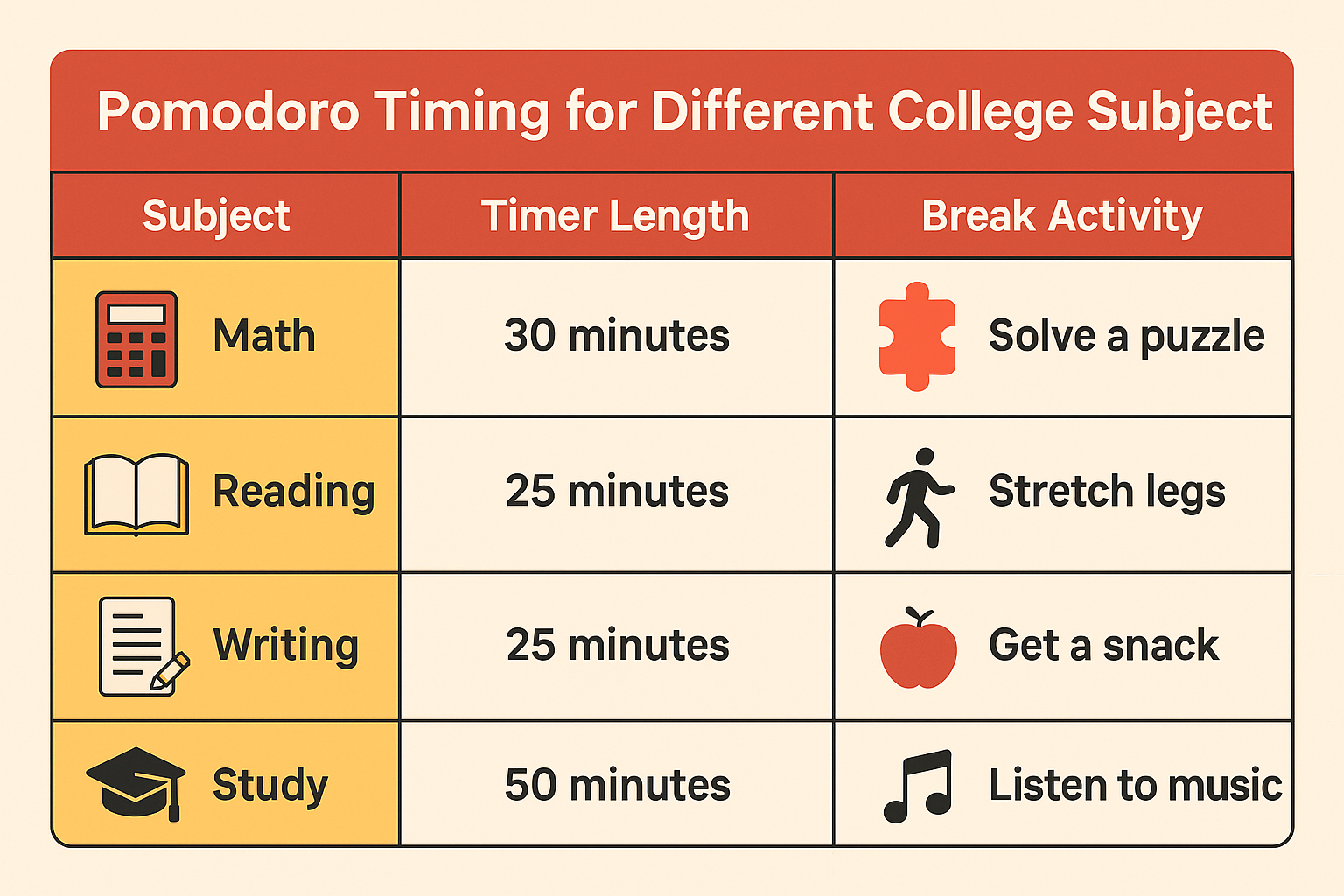
Creative tasks like essay writing, research projects, or lab reports often work best with longer initial pomodoros to help you get into the zone, followed by shorter review and editing sessions. The key is paying attention to your own natural rhythms and energy patterns, then adjusting accordingly rather than rigidly sticking to arbitrary time limits that don’t serve your actual learning needs.
Subject Specific Adaptations:
Subject Type942_30b0fc-fa> |
Recommended Length942_fdc2bf-39> |
Best Break Activities942_91fc2d-40> |
Why It Works942_8ec596-09> |
|
Reading/memorization 942_9a70e8-0d> |
20 – 25 minutes 942_30a5e3-72> |
Walk, stretch, hydrate 942_678239-dc> |
Prevents information overload 942_573b66-86> |
|
Problem solving 942_c9af85-da> |
30 – 45 minutes 942_fcb774-47> |
Physical movement or fresh air 942_4e4ea8-d9> |
Allows for deep thinking cycles 942_86cf67-00> |
|
Writing/creative work 942_2265cc-15> |
25 – 50 minutes 942_d89cf9-e1> |
Complete mental break 942_cbb7e2-10> |
Supports creative flow states 942_bf0c30-66> |
|
Review practice tests 942_9fe6fb-56> |
20 – 25 minutes 942_99a5d1-20> |
Light snack, brief social chat 942_2b53c8-bd> |
Maintains energy and motivation 942_5f6aeb-05> |
Common Mistakes That Sabotage Your Learning Success
Even with such a straightforward technique, students often make critical errors that completely undermine its effectiveness and prevent it from becoming one of their go to effective learning strategies. The biggest mistake is treating those 5 minute breaks as optional or using them to check social media, text messages, and other highly stimulating digital activities that fragment your attention.
Those brief breaks aren’t just downtime; they’re an essential component of the system that allows your brain to consolidate information and recharge for optimal performance. Scrolling through Instagram or checking Snapchat during breaks floods your brain with dopamine and competing information, making it much harder to refocus when the next work session begins.
Another common error is being overly rigid about timing when circumstances genuinely call for flexibility. If you’re in the middle of solving a complex calculus problem and the timer goes off right as you’re about to reach the solution, it’s perfectly fine to finish your thought process before taking that break. The technique should serve your learning, not become a tyrannical master that disrupts your natural thinking patterns.
Students also frequently pack way too much into single pomodoros, then feel discouraged and defeated when they don’t complete everything they optimistically planned. Start with conservative, realistic estimates of what you can accomplish in 25 focused minutes, then adjust your expectations based on actual experience rather than wishful thinking about your superhuman productivity potential.
Technology Tools That Enhance Your Study Sessions
While you absolutely don’t need fancy apps or expensive gadgets to implement effective learning strategies like the Pomodoro Technique, the right digital tools can definitely make the process smoother, more engaging, and easier to stick with long term. Forest has become incredibly popular among students because it gamifies the experience by growing virtual trees during your focus sessions and creating an entire digital forest over time.
Cold Turkey and Freedom are excellent choices for students who struggle with digital distractions during study sessions. These applications can temporarily block access to social media platforms, gaming websites, or other tempting online destinations during your pomodoros, removing the temptation entirely rather than relying on your willpower to resist clicking over to Twitter.
For students who enjoy tracking their progress and seeing concrete evidence of their productivity improvements, apps like Toggl or RescueTime can help you identify patterns in your focus levels and determine which times of day or types of tasks work best with your natural energy cycles and attention rhythms.
Recommended Pomodoro Applications:
- Forest: Gamified focus sessions with virtual tree growing rewards
- Be Focused Pro: Clean, minimalist interface perfect for iOS users
- PomoDone: Seamlessly integrates with existing task management systems
- Focus Keeper: Highly customizable intervals with gentle break reminders
- Brain Focus: Android friendly option with detailed productivity statistics
Handling Interruptions Like a Productivity Pro
Real life doesn’t pause respectfully for your pomodoros, and learning to handle inevitable interruptions is absolutely crucial for long term success with this and other effective learning strategies. When someone interrupts you during a focused work session, quickly jot down their request or write a note about where you left off, then politely ask if you can address their concern during your upcoming break.
Internal distractions often prove trickier to manage than external ones because they feel more urgent and personally relevant. When random thoughts, brilliant ideas, or sudden worries pop into your head during a focused session, resist the immediate urge to act on them or let them derail your concentration. Instead, quickly scribble them down on a piece of scrap paper and return your attention to the task at hand.
This external brain dump technique prevents you from forgetting genuinely important thoughts while maintaining your focus on the current priority. If you consistently struggle with the same types of mental distractions, it might be worth examining whether your study environment, preparation routine, or even your underlying stress levels need some attention and adjustment.
Building Sustainable Habits for Academic Success
The real magic of incorporating effective learning strategies like the Pomodoro Technique isn’t found in individual study sessions; it’s in how consistent practice gradually rewires your relationship with work, productivity, and academic challenges over the long term. Regular use helps you develop much better time estimation skills, significantly reduces procrastination tendencies, and builds genuine confidence in your ability to tackle even the most intimidating assignments.
Start small and build your practice gradually rather than trying to pomodoro your entire academic schedule from day one. Pick one particularly challenging subject or type of task and use the technique consistently for that specific area until it feels natural and automatic. Once the rhythm becomes second nature, you can expand to other areas of your academic life without feeling overwhelmed.
Track your progress not just in terms of tasks completed or hours studied, but in qualitative measures like how you feel during and after study sessions. Are you less mentally exhausted at the end of long study days? Do you feel more confident about tackling difficult material? These subjective improvements are often more meaningful than pure productivity metrics.
Combining Pomodoros with Other Proven Study Methods
Effective learning strategies work best when they complement and enhance each other rather than competing for your attention and energy. The Pomodoro Technique pairs beautifully with active recall practice, spaced repetition systems, and other evidence based study methods that many successful students swear by.
Active recall exercises fit perfectly into 25 minute focused sessions, whether you’re testing yourself with flashcards, explaining concepts out loud, or working through practice problems without looking at solutions. The time constraint adds beneficial pressure that can actually improve your recall performance and help identify knowledge gaps more quickly. We have a complete post for Active Recall, you can check it out here (the definitive guide: Active Recall vs Passive Review, Which Works Better?)
Spaced repetition reviews can be easily scheduled and managed using pomodoro intervals, creating a systematic approach to long term retention that feels manageable rather than overwhelming. Use one session to review older material, the next to tackle new concepts, and a third to practice applying everything together in novel contexts.
The Brain Science Behind Why This Method Works So Well
Understanding the neurological reasons why the Pomodoro Technique ranks among the most effective learning strategies can help you use it more strategically and maintain motivation during challenging periods when you’re tempted to abandon structured approaches. Research on attention and cognitive load clearly shows that our brains naturally experience focus fluctuations throughout the day, and attempting to maintain peak concentration for extended periods inevitably leads to mental fatigue and significantly decreased performance.
Those regular breaks aren’t just rest periods for a tired mind; they’re opportunities for your brain to consolidate new information, form connections between concepts, and process what you’ve been learning at a deeper level. This explains why students often experience sudden insights, remember important details, or solve tricky problems during their break times rather than while actively grinding away at their books.
Time boxing also creates beneficial psychological pressure that can enhance focus quality and reduce perfectionist tendencies that often paralyze high achieving students. When you know you only have 25 minutes to work on something specific, you’re much more likely to start immediately rather than procrastinating until conditions feel absolutely perfect for maximum productivity.
Troubleshooting When the Method Feels Ineffective
Sometimes students enthusiastically try effective learning strategies like this for a few days, then decide it’s not working for their particular learning style or academic demands. Often though, the issue lies in implementation details rather than fundamental incompatibility with the method itself. Pay attention to these common adjustment needs.
If you consistently find it difficult to focus even for 25 minutes, try starting with shorter intervals like 15 or 20 minutes and gradually building up your attention span over several weeks. Some students need to develop their focus muscles slowly, especially if they’re recovering from years of scattered, multitasking study habits.
Conversely, if you’re regularly finishing assigned tasks well before the timer goes off, you might be underestimating your capabilities or choosing work that’s too simple to genuinely challenge your thinking. Push yourself with more substantial goals that require the full time period to complete effectively and meaningfully.
Making It Work with Your Crazy College Schedule
Integrating effective learning strategies into your existing routine requires strategic planning, especially when juggling irregular class schedules, part time jobs, social commitments, and the general chaos that defines most college experiences. Look for natural transition periods in your day where you can fit productive pomodoros without feeling rushed or stressed about the next obligation.
The time between classes often works perfectly for shorter review sessions, quick problem sets, or reading assignments that don’t require hours of sustained concentration. Evening study blocks can accommodate longer sequences of pomodoros with extended breaks for meals or social time. Weekend catch up sessions can use modified timing to tackle larger projects requiring sustained attention and creative thinking.
Be realistic about what you can actually commit to consistently rather than creating overly ambitious schedules that crumble at the first sign of academic pressure or social temptation. It’s much better to complete three high quality pomodoros daily than to plan for eight sessions and actually finish none of them.
Your Transformation Journey Starts Right Now
Learning to effectively implement this technique isn’t just about improving individual study sessions; it’s about developing a healthier, more sustainable relationship with work and productivity that will serve you well beyond graduation and into your professional career. The skills you build around focus, time management, and task completion will prove incredibly valuable throughout your working life.
The beauty of this approach lies in its fundamental simplicity and universal accessibility. You don’t need expensive equipment, extensive training programs, or perfect environmental conditions to get started making positive changes. All you need is a basic timer, willingness to experiment with new approaches, and patience to let beneficial habits develop naturally over time.
Remember that everyone’s optimal implementation will look slightly different, and that’s perfectly fine. The goal isn’t to follow someone else’s system with rigid perfection; it’s to find what works best for your unique learning style, schedule constraints, and academic demands. Start with the basic framework, then adapt and modify based on your actual experience rather than theoretical ideals.
Among all the effective learning strategies available to college students, this one stands out for its proven track record and immediate accessibility. Your future self will genuinely thank you for developing these focused work habits today, and the students who master sustainable productivity techniques don’t just earn better grades; they experience less stress, enjoy more free time for activities they love, and build confidence that carries over into every area of their lives.
The timer is ready, your workspace is prepared, and you’ve got everything necessary to transform how you approach studying and time management. What’s the first challenging subject you’re going to tackle with these powerful new effective learning strategies?


